
The Ultimate Guide to Organising Your Pokémon Binder by Set
If you want to organise your Pokémon binder by set, you are choosing the system most completionists swear by. Grouping cards by expansion and card number shows you at a glance what you own, what you are missing and how close you are to finishing a set or master set.
This is Rare Zone’s definitive by-set method for UK collectors: why it works, a seven-step process from sorting the pile to labelling the shelf, how to handle promos and subsets, and the simple habits that keep a by-set binder tidy as new expansions arrive. Track your progress as you go in the free Collection Tracker.
Open Collection TrackerSee Pokémon sets in order
Why organise your Pokémon binder by set?
There are plenty of ways to sort Pokémon cards — by type, generation, rarity, artist or simply favourites. Organising by set gives you a structure that already exists on every card: the set symbol and card number. That makes it the most reliable system for anyone working towards complete sets or master sets.
Keeping cards grouped by set makes it easier to:
- Track card numbers and spot gaps immediately.
- Keep duplicates organised instead of mixing them into your main collection.
- Separate expansions and eras so the collection stays easy to browse.
- Keep special collections apart from the main numbered sets.
- Build a consistent binder system that scales as your collection grows.
Organising by set vs other binder methods
By set is not the only option, but it is the easiest to maintain over years of collecting. Here is how it compares:
| Method | Best for | Trade-off |
|---|---|---|
| By set & number | Set and master-set collectors | Needs space planned per set |
| By type or colour | Display and aesthetic binders | Hard to see what is missing |
| By Pokédex number | “One of every Pokémon” goals | Mixes eras and sets together |
| By favourite / character | Personal showcase binders | No natural completion point |
Many collectors use a hybrid: a by-set binder for anything they are completing, plus a separate favourites or display binder. If you need the release order to arrange your shelf, our Pokémon sets in order guide lists every English set by era.
Step by step: how to organise your Pokémon binder by set
1. Gather your cards and supplies
Before you start sorting, get everything in one place:
- A suitable trading card binder (side-loading pockets help keep cards secure)
- Card sleeves for anything you want extra protection on
- Spare binder pages, where your binder uses them
- Temporary sticky notes or dividers
- Your Pokémon cards, ready to sort
With a large collection, work through one era or group of sets at a time rather than emptying everything at once. It keeps the table manageable and stops cards from different projects getting mixed up.
2. Identify the set for each card
Use the set symbol and card number printed at the bottom of each card to work out which expansion it belongs to. Modern cards also show a set code next to the number, which makes identification quicker.
Create a separate pile or temporary section for each set and keep going until every card in your batch is grouped. Keep a checklist nearby — or open the set in the Collection Tracker — so you can log what you have as you sort.
3. Sort each set into card-number order
Once a set is grouped, put the cards into number order. Main numbered cards come first, followed by secret rares (numbers above the printed set total). Ordering by number means an empty pocket instantly tells you which card is missing.
Tracker tip: Log each set in the Collection Tracker as you put it in order. Your missing list is then ready before the cards even go into the binder.
4. Plan the space each set needs
Decide how much room each collection gets. A smaller set may share a binder with others from the same era, while a large modern set — especially a master set with reverse holos — may need its own dedicated binder.
Leave a little extra space where possible. Reserving pockets for missing cards means you can slot them in later without reorganising the entire binder. If you are planning a master set, the Pokémon 151 master set checklist is a worked example of how quickly page counts grow.
5. Label your binders with set logo stickers
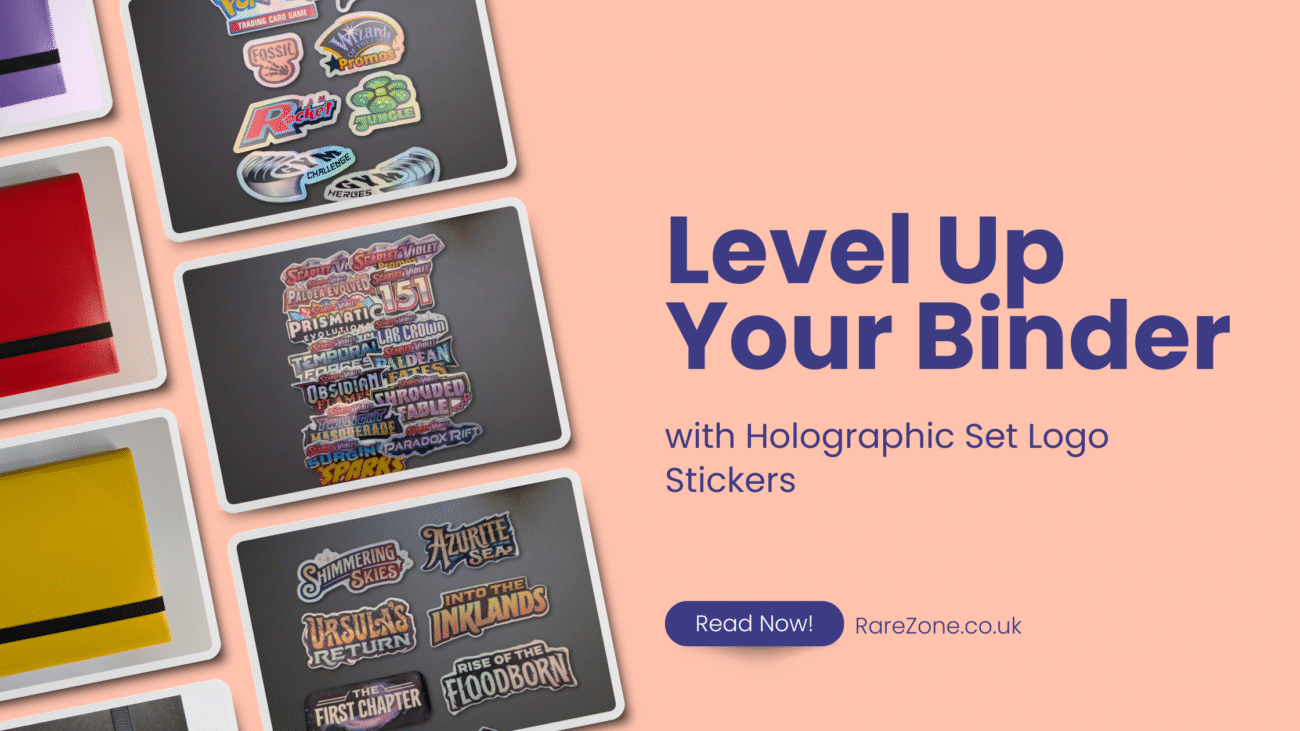
Once a set section is stable, labelling the binder makes each collection identifiable at a glance. Holographic set logo stickers add the matching Pokémon TCG set logo to the front or spine of your binder.
Use the same sticker position on every binder for a consistent look — a whole shelf then reads like a library. For example, one shelf section for vintage sets, one for Sword & Shield and one for Scarlet & Violet, each binder clearly labelled. Our guide to holographic set logo stickers covers placement and sizing in more detail.
6. Add binder tags for quick identification
Binder tags are another way to identify sets, especially when one binder holds several expansions or you want a more visible marker. Rare Zone’s Pokémon binder tags use set-themed designs and attach to a suitable binder ring, loop or external attachment point. If you like extra shine, there are also holographic binder tags.
Not sure which to use? Read binder tags vs binder stickers — the short answer is that many collectors use both.
Browse binder stickersBrowse binder tags
7. Arrange the shelf by era
With every binder organised and labelled, line them up in release order — or group them by era. Browsing then feels like walking through Pokémon TCG history, and you will always know where a new binder belongs. Shop by Era is a handy way to find labels for the eras you collect.
Keeping promos and special sets organised
Not every Pokémon card belongs to a standard numbered expansion. Promos, special collections, subsets and limited releases are easier to manage in dedicated sections rather than mixed into your main set runs. Consider separate sections for:
- Promo cards (by era or promo series)
- Trainer Gallery, Galarian Gallery or similar subsets
- Special expansion cards
- Oversized or unusual cards (store these separately)
- Cards you are keeping aside for trading
The right setup depends on your collection; what matters is choosing a system you can maintain as it grows.
Keep a master index of your collection
Once you have more than a handful of binders, a master index saves a lot of page-flicking. It should show:
- Which sets you own
- Which binder contains each set
- Cards you are still missing
- Duplicates available for trade
- Sets you want to start in future
A spreadsheet or printed checklist works, but the Collection Tracker is built for exactly this: choose an era, open a set and record how many copies of each card you own, so your missing list is always up to date.
How to keep a by-set binder up to date
Once the system is in place, maintaining it takes minutes. When new cards arrive:
- Identify the set before filing anything away.
- Update your checklist or Collection Tracker.
- Slot the card into its reserved pocket in number order.
- Move duplicates to your trade section.
- Add or update binder labels when a new set gets its own space.
Small, regular sessions beat one enormous sort later. Treat every booster opening as a two-minute filing job and your binder will never drift back into an unsorted pile.
FAQ: organising a Pokémon binder by set
What is the best way to organise a Pokémon binder by set?
Group cards by set symbol, put each set in card-number order, reserve pockets for missing cards and label the binder once the section is stable. Track ownership alongside so you always know what is missing.
Should every set have its own binder?
Not necessarily. Smaller sets can share a binder with others from the same era. Large modern sets, and master sets in particular, usually justify their own binder.
Where do secret rares go?
After the main numbered cards, in number order. They are part of the set, so keeping them at the end of the section keeps the numbering logical.
How do I label a binder that holds several sets?
Use a set logo sticker for the main collection on the spine or front, and binder tags to flag the other sets inside. See tags vs stickers for ideas.
How do I know which set a card is from?
Check the set symbol and number at the bottom of the card. Modern cards also print a set code. Our sets in order guide helps place each set in its era.
Ready to organise your collection by set?
There is no single perfect system, but for most collectors the combination of cards organised by set, a tracked checklist and clearly labelled binders is the one that lasts. Whether you are sorting WOTC classics, Sword & Shield or the latest Scarlet & Violet and Mega Evolution releases, a consistent approach makes collecting more enjoyable and your progress easy to see.
Add a review
Your email address will not be published. Required fields are marked *